
 In the Fall of 1777, the countryside was in an uproar. The previous summer, the “colonies” had declared independence, but now those chickens had come home to roost. The British army landed 17,000 troops at the head of the Chesapeake Bay, and they arrived in Pennsylvania in early September. George Washington and his troops had set up a defensive position along the Brandywine Creek to stop the British advance, but on September 11, 1777, they were defeated in a hard-fought battle now called Brandywine.
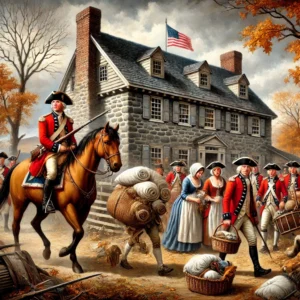
 The British moved through the countryside over the next few days, aiming to cross the Schuylkill River near Valley Forge, with the American troops following them. The British had marched from the Chesapeake, and so their supply lines were quite long. Their solution: they requisitioned what they needed from the countryside.
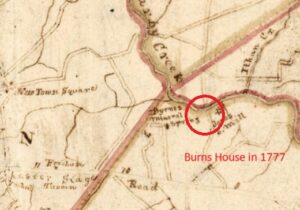
On September 19th, the British army, camped near Howellville, sent out raiding parties to capture supplies. Lieutenant Colonel William Harcourt was the commanding officer of the 16th Queen’s Light Dragoons, a light cavalry unit that was used for scouting and, on this day, raiding. The British made the rounds of Newtown, Radnor, Haverford, and the tip of Marple where the Burns farm overlooks Darby Creek. The Burns reported large losses:
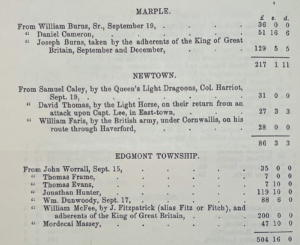
British Capt. John Montressor summarized the raid as follows:
“Lt. Col. Harcourt with a party of dragoons and Light Infantry made an Excursion on the Philadelphia road and brought in 150 horses, which were much wanted, got from New Town square 6 miles from hence.” Much more was taken. Nicholas Pechin of Haverford added a note to his claim saying “In a word, a number of things too tedious to mention; as not even a spoon left to eat my victuals, nor a comb to comb my hair.”
 William Burns, Jr., 21 years old, was left hopping mad by this and a subsequent raid in December. A Quaker, he could not, in good conscience, turn the other cheek. He and another local boy, James Lawrence, joined the local militia.
The local farmers got off relatively easy that day. The next day, General Wayne and his troops were surprised by a midnight British raid of their camp in Malvern. The British swept into the darkened camp with only bayonets and took a fearful toll of 53 American lives.
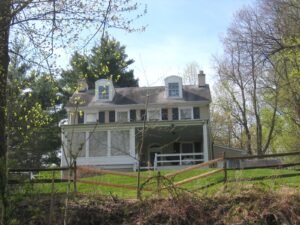
The Burns house remains today, overlooking Darby Creek – a witness to history.
For more on the history of Marple, visit the Marple Historical Society website and Facebook page, and join the Society to keep up to date on coming events: www.MarpleHistoricalSociety.org