
 Marple Township has the dubious distinction of being the location of the first murder in Chester County. Who was involved?
Jonathan Hayes Jr., was only one year old when he arrived in Marple in 1683, the son of Jonathan Hayes, Sr. and Ann Williamson, English Quakers. He grew up helping his family on the farm in the sparsely settled frontier that was Marple. There were 15 original families in Marple, spread out across the township. Their primary social occasions were Sundays when they attended Quaker Meeting and were able to spend time with their neighbors. From the Hayes home, the nearest Quaker Meeting was at Radnor, and so that is where they attended. Jonathan met a Welsh woman from Merion Meeting, Jane Rees, and they were married at Radnor in 1709.
 Near the Hayes house on the Newtown border was the mill of John Pugh. His son Hugh Pugh was a wheelwright, and friend of Lazarus Thomas, a laborer. In the early winter of 1715, the paths of Hayes, Pugh and Thomas collided in Marple. The details are lost to history but there was an argument, Hayes attempted to break up the quarrel and was killed. Pugh and Thomas were charged with murder.
In the early colonies, there were no regular jails, and so the accused were released on bail. There was also no regular sitting court, and so justice had to wait for the judges to set a court date, and for jurors to be summoned. The Quakers of that day did not swear oaths, even when sitting on a jury. That created an opening for a wily defense attorney to challenge any trial with Quaker jurors. For three years, the accused murderers roamed free. Accounts say the accused were leaders of a “Lawless Gang of Loose fellows, Common Disturbers of the public peace,” and “were so hardened and became so audacious  as still to continue in their publick Rioting, Caballing and fighting.”
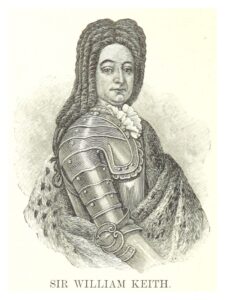
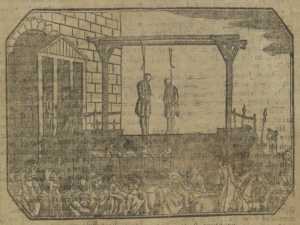
On April 17, 1718, the men were finally brought to trial, with Chief Justice Lloyd and four justices of the Supreme Court present, along with Governor Sir William Keith, and a jury of mostly Quakers. The men were convicted, Governor Keith finding the crime “so black” as to justify the death penalty. The men were hung in Chester on May 9, 1718. The judges had simply ignored the legal issue of Quakers not being sworn. But within the month the law was changed so that a juror could “swear or affirm” to tell the truth. Apparently, the thought was “Bad men were hung.” And so the fact that the law was changed after their death did not weigh heavily on the conscience of Lady Justice.
For more on the history of Marple, visit the Marple Historical Society website and Facebook page, and join the Society to keep up to date on coming events: www.MarpleHistoricalSociety.org