
 From time immemorial, farmers celebrated the successful gathering of fall crops, hoping the harvest would carry their families and communities through the winter. Over time, this tradition evolved into larger community gatherings known as “Harvest Home,” complete with singing, dancing, feasting, rides and speakers.
From 1899 to 1904, Edgmont Township’s Castle Rock Park hosted one of southeastern Pennsylvania’s largest rural gatherings: the Tri-County Harvest Home Festival. In its first two years—1899 and 1900—it drew over 10,000 visitors from Delaware, Chester, Montgomery and Philadelphia counties.
The Chester Times described the event as both a picnic and a reunion. Farmers, politicians, businessmen and families mingled in a celebration that combined rural thanksgiving, popular amusement and civic engagement. In 1899 alone, more than 1,200 carriages lined the grounds, while bicycles and West Chester trolleys brought even more attendees.
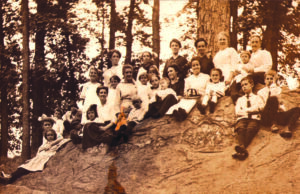 Castle Rock Park was well-equipped for such gatherings: a dance pavilion, shuffleboard, a merry-go-round, athletic contests and live bands set the stage for revelry. Musicians performed throughout the day, and a minstrel troupe added entertainment. Men pitched quoits, children ran races, and hundreds of miniature American flags were released during the patriotic flag-raising ceremony in 1899. A highlight in 1900 was when balloonist B. D. Bowen ascended to 4,000 feet and then jumped out of his balloon–his parachute floating him safely to ground, to the delight of the crowd.
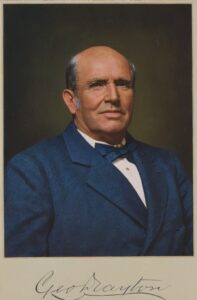
However, Harvest Home was more than simple fun—it served as a forum for political and civic discourse. In 1899, the Hon. Thomas V. Cooper of Media, a veteran legislator, warned of the dangers of monopolies and trusts while paying tribute to the Stars and Stripes. In 1900, “Uncle George” 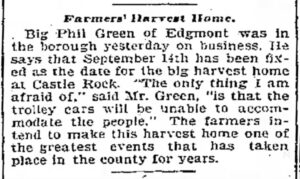 Drayton, a respected community leader raised in Marple, delivered a nostalgic address weaving together local history, farming traditions and personal reminiscences of 19th-century Delaware County. Recalling his boyhood, he remarked, “Marple at that time had many queer people living in it. If Dickens had been acquainted with some of these characters, he could have written volume after volume.”
By blending rural fellowship with civic discourse, Harvest Home became as much a public forum as a fair. Its success lay not just in its scale, but in its symbolism. Committees of farmers from each county, organized the festival, and their names filled the pages of the Chester Times. In essence, Harvest Home embodied the spirit of regional unity, bringing three counties together to celebrate agricultural abundance and community life.
Despite several successful events, repeated rainouts eventually led to its end. The final Harvest Home at Castle Rock was held in 1904, and the park itself closed a year later, in 1905.
For more on the history of Marple, visit the Marple Historical Society website and Facebook page, and join the Society to keep up to date on coming events: www.MarpleHistoricalSociety.org