
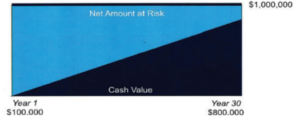
 More Americans are turning to cash-value life insurance as a way to add tax-diversification to their investible assets. Two types of cash-value life insurance policies are Dividend-Paying Whole Life (WL) and Indexed Universal Life (IUL).
Whole Life, a mainstay of the insurance industry for nearly 100 years, works like this:
- The policyholder pays a premium to the insurance company to initiate the policy.
- Annual premium supports a given death benefit based on:
- the minimum interest rate insurance company estimates it could credit in a “worst case scenario”, and
- the maximum mortality and expense charges.
- Insurance company actuaries determine actual experience and make adjustments to initial premiums by declaring annual dividends which can:
- increase the policy cash value,
- purchase additional death benefits, or
- be used to pay next year’s premium.
Indexed Universal Life, developed in the late 1990s, works like this:
- The policyholder pays a premium to the insurance company to initiate the policy.
- Annual premium is more than required to support a minimum death benefit, allowing additional cash value to accumulate in the policy.
- Annual expenses and mortality charges are established and charged each year.
When evaluating WL or IUL, it’s important to consider three factors that will impact consumer experience and value:
- Financial Ratings of the Company – A life insurance policy is a long-term financial investment. Regardless of policy type, it’s best to use sound, highly-rated insurers.
- Emphasis on Savings Component versus Death Benefit Component – If structured properly, WL and IUL policies can be used for the twin needs of cash value accumulation and death benefit protection. Many savers want death benefit protection but don’t want to sacrifice cash value growth for more protection than they need. The IRS has established a set of rules that specify the minimum death benefit component that will allow an insurance policy to qualify for tax-free savings treatment.
- Interest Crediting Method – How interest is credited is very different between WL and IUL. In a WL policy, credited interest is tied to internal carrier decisions through annual dividends. In an IUL policy, credited interest is tied to an external index such as the S&P 500, subject to an annual floor and cap.
WL and IUL use different approaches in delivering value to policyholders. In general, WL policies tend to favor a higher death benefit at the expense of cash value growth. Conversely, IUL policies tend to favor cash value growth while keeping the death benefit closer to the IRS minimum.
As with any financial decision, the needs of the client (death benefit, tax-free income or wealth transfer) will determine which product is the best fit.