
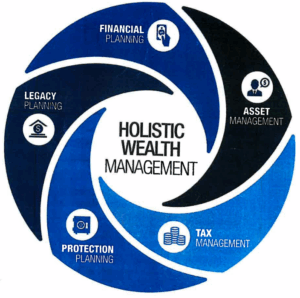
 The five pillars of holistic wealth management are all equally important in helping you achieve your goals and optimizing your financial resources. Most individuals and families are forced to meet with different professionals when seeking advice on their financial, investment, tax, insurance, or legal needs. These professionals (banker, stockbroker, accountant, insurance agent and attorney) typically operate in silos and often don’t collaborate on your behalf. In many cases, each professional is just trying to sell their individual products or services. As a result, you may have the pieces to the puzzle (bank accounts, investment products, tax returns, insurance policies, wills and power of attorney) but no clear picture on how they all fit together.
Pillar One: Financial Planning – Planning for market volatility, rising taxes and longer life expectancies can be challenging. Invest too aggressively today and you risk principal loss. Invest too safely today and you risk losing future purchasing power. What are the uncovered opportunities in your financial plan and when was your plan last updated?
Pillar Two: Asset Management – When it comes to asset management, no one size fits all. Quality and cost-efficient investment portfolios should give investors access to alpha (active account management), indexing (broad market exposure), and evidence-based (portfolio shifting) strategies. Is your current investment strategy and asset mix congruent with your goals?
Pillar Three: Tax Management – Most people think of taxes only when it’s time to write a check to the IRS. Not all money is taxed the same. There are many ways to proactively manage and mitigate yearly and lifetime taxes to reduce your overall tax burden. Does your existing plan maximize after-tax returns by coordinating asset management with tax management?
Pillar Four: Protection Planning – True wealth management isn’t just about growing assets – it’s also about protecting what you’ve built. Insurance is designed to protect income and prolong the assets you have. Proper insurance planning may be a tool to enhance tax efficiencies. When was the last time this piece of your financial puzzle was reviewed?
Pillar Five: Legacy Planning – Your legacy is about more than money – it’s about impact. Three questions you need to answer when it comes to legacy planning: 1) Where does my money go? 2) Who’s in charge? and 3) What are the rules? If there are three places your money could go to (family, charity or IRS) and you could only pick two, which two would you choose?
Investment decisions don’t exist in a vacuum – they impact everything from goals to risk to taxes to protection to legacy planning. The five pillars of holistic wealth management are all equally important in helping you achieve your goals and optimizing your financial resources.